


.png)
A Stay at The Historic The Tokyo Station Hotel, a Member of Small Luxury Hotels of the World – Review

TOKYO
It’s an unmissable sight in the centre of Tokyo with its impressive red brick exterior. Unbeknownst to many, inside this eye-catching building outside of Tokyo Station is actually a functioning hotel. In fact, it’s been running since 1915. Welcome to The Tokyo Station Hotel, a member of Small Luxury Hotels of the World.

The History and The Design
While The Tokyo Station Hotel opened in 1915, the story began much earlier during the Edo period, when the location where the hotel now stands was once part of the sea. As the surrounding castle town, including Edo Castle, expanded, it gave way to new areas of land. Then, Japan entered an era of rapid modernisation during the subsequent Meiji and Taisho eras, and one of the country’s great planning feats was the opening of Tokyo Station in 1914. Its iconic red brick building became a symbol of Japan’s modernisation and became the landing pad to the capital city. A year later, The Tokyo Station Hotel opened its doors, with the aim of accommodating distinguished guests visiting the city.
The mind behind the red brick exterior is Kingo Tatsuno, one of the most influential figures in Western-style architecture. He studied under British architect Josiah Conder, known as the father of modern architecture, in London. The Tokyo Station Hotel is the only hotel in Japan that sits inside a designated National Important Cultural Property of Japan. One of its most iconic features is the two cupola domes on the North and South sides. The domes are decked in European decor and traditional ornaments that symbolise Japanese spirit and elements. Both commuters (from the Marunouchi exit) and guests (through the Archive Balcony) can admire these details.
With its storied past, the hotel has witnessed countless events. It survived the Great Kanto Earthquake in 1923 but was battered by air raids during World War II. The damage extended to its iconic domes and third floor, which was eventually cut down to two storeys. Both underwent reconstruction work. In 1951, it resumed business and operated for 55 years before another major remodelling in 2006. As a designated Important Property, the exterior remained the same, although the difference between the second- and third-floor bricks is visible from the outside. After restoration, the hotel reopened in 2012, back to its former glory but designed for contemporary times.

The Arrival and the Location
It was raining when I arrived at Tokyo Station, and I immediately thought that it wasn’t a great welcome to the city I once called home. That immediately faded when I finally reached the Marunouchi exit after a long and winding walk through the busy Tokyo Station. The summer holidays were about to end. Thankfully, the hotel is connected to the station so you don’t even have to go out, rain or shine. In contrast to Tokyo Station, which can be considered the beating heart of the city as bullet trains arrive in and out, The Tokyo Station Hotel is pulsating with its own beat—that of enthusiastic travellers, all with their own stories. Entering the hotel from the busy train station instantly feels like being wrapped in time. Suddenly, I’m inside a historical landmark that’s actually a hotel.
The European-inspired decor by the British company Richmond International instantly stood out. After all, they are known for their work on transforming old buildings into modern facilities. The Tokyo Station Hotel is their first project in Japan. At check-in, I received a leaflet detailing a self-guided tour of the hotel’s highlights. Thanks to that, I was able to explore the hotel at my own pace and find out hidden tidbits that I otherwise wouldn’t know. I immediately noticed the clematis flower on the floor and furnishings. It’s also one of the decorations on the dome. It’s a fitting choice as the flower symbolises “traveller’s joy,” representing safe journeys, happiness while travelling, and even the joy of adventures. This mirrors The Tokyo Station Hotel and Tokyo Station, which were built to welcome and accommodate travellers.
The hotel’s location is simply unrivalled even among neighbouring hotels. To put it into perspective, it’s quite literally inside the train station. To be more exact, the rooms are located below the station, and the trains are running above. Nearby, there are many cultural landmarks to visit such as the Imperial Palace, Ginza, and Yurakucho. What makes the hotel stand out even more is that there’s a large open square in front, giving any onlooker an unrivalled view of the exterior. Its radiant red brick exterior is a standout among the neighbouring glass, concrete, or grey skyscrapers and even more so at night when it glistens among the Tokyo cityscape.

The Rooms
A staff member led me to my room and gave a brief, yet helpful, introduction to the room’s features. The Tokyo Station Hotel has 150 rooms and suites across four floors, most of which are located on the first three floors, as the fourth floor serves as the attic. Only two rooms are in the attic: the expansive 95-square-metre Ambassador Suite and the two-bedroom Imperial Suite.
I stayed at the 40-square-metre City View King Room, which comes with dynamic views of Marunouchi and the promenade around Tokyo Station. These rooms are arranged along the north-south side of the station building so guests can see the streetscape closely. Because of this, the room appears bright thanks in part to the natural sunlight from the windows as well as the glass chandelier.
I have no complaints about the room, but for my personal preference, I would have liked to stay at the Dome Side room instead, which offers a closer look at the relief of the Tokyo Station Dome above. As someone who was born, raised, and lived in three big cities, views of the city aren’t new to me, especially since I also lived in Tokyo. A view of a historic dome, however, would have been a different experience. From what I was told, the Dome Side rooms are only available to local guests.
In terms of layout, the room is compact with European-inspired decor and furnishings. The windows are tall, accompanied by equally elegant-looking curtains. The bed is also spacious, featuring a thick Simmons mattress with a soft quilted top for maximum comfort. By all accounts, the room is simple yet evokes a timeless look. It doesn’t try to be modern, save for the WiFi. The TV isn’t a smart TV, the control panels are straightforward, the lamps are vintage, and even the stationery is old-school (Genko yoshi or Japanese manuscript paper). It’s an interesting mix of being frozen in time, but somehow also moving past it with its elevated setting.
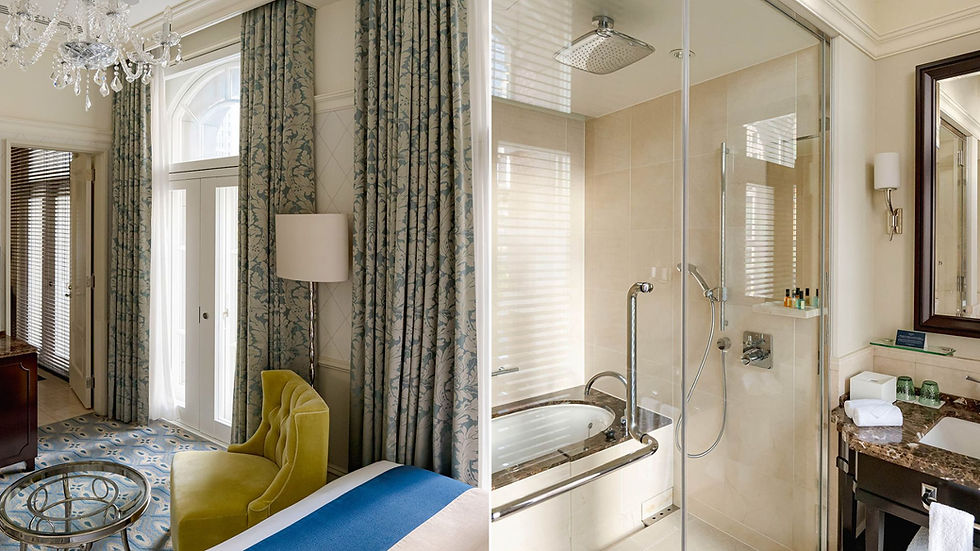
The bathroom includes both a rain shower and a bathtub, as well as a range of amenities. I’m slightly surprised that the amenities aren’t in bigger bottles, instead in travel sizes. But they’re generous in replenishing them daily. The bar area is on the conservative side, but you have the essentials such as coffee, tea, and water. Only water is complimentary; the rest of the drinks in the mini-bar aren’t. While the room seems like it lacks items, they are actually available on request, such as a desk lamp, different types of pillows (buckwheat or memory foam and such), ice packs, bath salts, or nail clippers.
There is also an in-room massage service available. I didn’t try it, but I thought that it was something great to offer so that guests don’t need to go elsewhere to enjoy a relaxing massage. The room also has a private dresser, although it needs a more user-friendly feature for putting your luggage. There is a rack, but it’s on the smaller side, which makes it more difficult to spread out bigger luggage. It may work for carry-on luggage, but City View is mostly for international travellers, so it’s a given that our luggage is on the bigger side. I ended up placing my luggage on the floor so it could be fully opened, which isn’t the most convenient.
The Maisonette Room and Maisonette Suite are the only two rooms in the hotel that have two storeys. It also has a distinctive residential-style layout featuring a living room downstairs and the sleeping quarters upstairs. The separate level allows for privacy and comfort.

The Dining
The Tokyo Station hotel is home to 10 dining options, including eight restaurants and two bars.
Breakfast is at The Atrium, located within the attic space of the hotel. It features nine-metre-high ceilings and a massive glass skyline that allows natural daylight. Across the 400-metre space lies an extensive buffet with over 100 items. Guests can enjoy Japanese specialties and seasonal vegetables, on top of made-to-order egg dishes. Exposed on one side of the loft space are the red brick walls and steel frames that survived the war.
The food labels include ingredients that those with dietary restrictions or allergies should avoid. That said, it was difficult to see that there were food items on the other side of the room. A sign indicating each section would have been useful, whether it’s the Japanese food section, the dessert section, the drink section, or the cooked food section — which I, unfortunately, had missed entirely. The seating layout blocked the view of the food on the other side, instead of having a dedicated space just for the food. The interior and decor were impressive, but the tables were a bit too close to each other, so I could unintentionally hear the conversations happening next to me.

The hotel’s signature restaurant is Blanc Rouge (meaning “white and red”), which offers French cuisine made with Japanese seasonal ingredients. The restaurant offers a front-row view of trains passing by Tokyo Station, without the frenzy. For local fare, head to Shichi Jyu Ni Kou, which serves Japanese cuisine inspired by the country’s seasons and 72 micro-seasons. For an authentic Edomae sushi experience, choose Sushi Asanogawa. Yakitori Seo, as its name suggests, is for yakitori lovers. Meanwhile, Cantonese En pays homage to Cantonese dishes with a focus on beauty, wellness, and anti-aging.
Enoteca Norio serves Italian cuisine paired with curated wines, while The Lobby Lounge is famous for its all-day light meals and afternoon tea. Then, there’s Toraya Tokyo, a cafe and shop of a five-century-old Japanese confectioner of the same name. Guests can savour traditional wagashi (traditional Japanese confectionery) and matcha, alongside light meals.

By day, retro-inspired restaurant Camellia offers light meals and afternoon tea. Come nightfall, it becomes an elegant bar serving cocktails and light bites. A distinct feature of the bar is the station hotel sign, which dates back to 1951. Similarly, the hotel’s bar, Oak, also features its distinct red brick walls on display. Here, whiskies from around the world are on full display, as well as artisanal cocktails like the aptly named “Tokyo Station.”
On my first night, I opted for in-room dining. They have breakfast, afternoon bites, and late-night comfort food available. I ordered a Margarita pizza with Vegan Cheese, and it arrived about 30 minutes later. You can order by phone or through your phone (via a QR code from the TV screen). The menu is also available through the TV screen.


The Facilities and the Experiences
For a building with so much historical weight, it only seems right that the hotel has its own History Gallery. The way they designed it is not just for simple viewing but with a purpose. For one, it documents the hotel’s past but, on a practical level, entertains guests as they walk through the 335-metre-long hallway. This long hallway is also one of the hotel’s noted features. The experience isn’t simply walking to get to your room but is akin to that of a museum or gallery.
Accompanying these archival pieces, ranging from historical photographs to architectural drawings and paintings related to the station, is a self-guided smartphone audio tour (via a QR code on each piece). The best part? Not competing for viewing space as you’d have in a traditional gallery or museum. The hallways are peaceful, so you can enjoy the over 100 pieces at your leisure.
The hotel puts its layered history in full view even in its dining establishments. On top of the brick walls, old decor from the domes is repurposed as wall artworks. The Archive Balcony on the South and North sides allows a closer view of the cupola domes. Look for the plasterwork, vaulted ceilings, and even the aircraft material used to cover the dome during restoration work, now used as pillars.

Beyond its historical past, The Tokyo Station Hotel is still a hotel, so naturally, there is a space dedicated to well-being and relaxation. An Spa takes its cue from the spirit of Japanese hospitality and offers facial and body treatments using Japanese products. Meanwhile, The Jexter Tokyo is a member-only fitness lounge equipped with state-of-the-art machines, ranging from cardio equipment to free weights. Then there’s the Thermal Bath and Relaxation area, complete with a carbonated bath, an artificial hot spring, and dry and steam saunas.
The Tokyo Station Hotel: Verdict
Come for the story but stay for the experience is the best way to describe The Tokyo Station Hotel. While newer, taller, and more modern hotels allow for maximum splurge, a hotel with a 110-year history (and counting) is a rarity, especially in an ever-changing big city. These days, it’s uncommon to see historical buildings torn down to give way to modern ones. In a way, the experience at The Tokyo Station Hotel feels like a novelty, a time capsule of sorts wrapped in red-brick grandeur.

During my stay, I had the chance to do a hotel tour with the hotel manager. While she was introducing the Maisonette room to me, we happened to have a good vantage point of the square outside the hotel. From there, we could see ongoing construction just next to us, in full view, given the hotel’s unobstructed views. That kind of sight is happening everywhere, not just in Tokyo and in my hometown of Hong Kong; it’s a daily occurrence. So more than ever, it’s great to see a “living heritage” like The Tokyo Station Hotel still exists, and one you can experience.
It’s a historical hotel by all accounts, with significant effort and work given to preserve as much of it as possible, while still functioning like a modern hotel. Its location is unbeatable, with plenty of hot spots nearby as well as less than 30 minutes by train to other major locations.
Address: 1-9-1 Marunouchi, Chiyoda-ku, 100-0005, Tokyo, Japan | Website: thetokyostationhotel.jp | Email: tsh.info@tokyostationhotel.jp | Instagram: @tokyostationhotel | Facebook: @tokyostationhotel
Disclaimer: The writer was invited by The Tokyo Station Hotel to experience the property. All observations, assessments, and opinions expressed are based on the writer’s independent experience and professional judgement.


Comments