


.png)
How a Gen Z Student Started Breer, A Sustainable Bread Beer Company, From a HKUST Dorm Room

INTERVIEW
Breer didn't start with a business plan. It started with a plate of leftover canteen food, a bakery bin full of unsold bread, and a founder who couldn't shake the guilt of watching it all go to landfill. Six years, one home brewing kit, and a chance encounter with a kvass-drinking bartender later, that guilt has become Hong Kong's most talked-about upcycled beverage brand — a company that's turned discarded bread into beer, partnered with the likes of Maxim's Group, 7-Eleven, and Hong Kong Tramways.
We sat down with Naman Tekriwal, the co-founder behind Breer, to talk about getting laughed out of breweries as a 19-year-old, why "bread beer" has become shorthand for the brand in Hong Kong, and what it actually takes to build a sustainability company that never let purpose get in the way of profit.
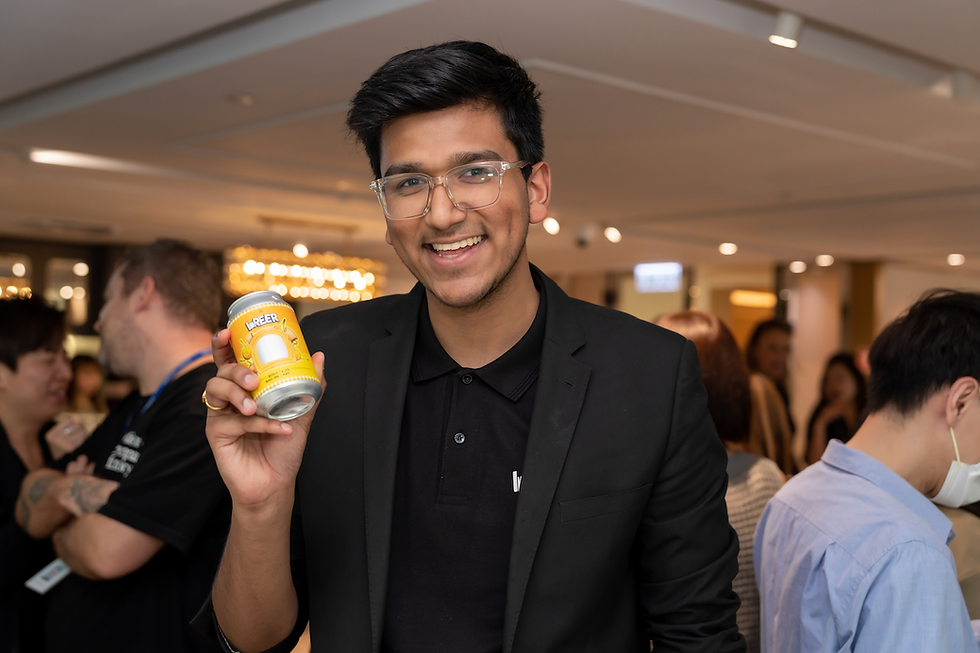
1) Breer famously started as a university dorm-room idea in Hong Kong. Take us back to the beginning. What were you doing in that dorm room, and what made you think, "This could actually become a business"?
Breer started at HKUST, and honestly, it started with guilt. I grew up in India, where wasting food is almost treated as a sin. So watching students pile up their canteen plates, eat a tenth of it and rush off to class genuinely bothered me. The campus bakery was also binning unsold bread every night.

The real moment came after a midterm. It was 9pm, nothing was open on campus, so we took a taxi to Tseung Kwan O and found one bakery still lit up. The owner let us sit and eat while he closed. As we ate, we watched him sweep every unsold loaf into a black rubbish bag. We asked what happens to it. Landfill, he said.
A week later, celebrating the end of exams in Lan Kwai Fong, I met a bartender drinking kvass, a Central Asian drink fermented from bread. That was the light bulb moment. We ordered a home brewing kit, learned to brew off YouTube, then surveyed 250 students and professors. 97% said they would try it. That was enough for us.

2) You were a young founder entering the beer industry. What was it like trying to convince breweries, businesses and investors to take a student-led idea seriously?
This was easily the hardest part of building Breer. We assumed bakeries would be the wall, because why would they care about two students? They turned out to be the easy part. There was so much surplus bread that plenty of them were glad someone wanted it.
Breweries were brutal. We messaged almost every brewery in Hong Kong and mostly got silence. The industry looked at us and saw kids doing a school project, and people told us that to our faces. Being written off purely because of our age was the single biggest obstacle of those early years, and it wears you down in a way nobody warns you about.
Our first yes came through the HKUST alumni network, from a head brewer who had studied chemical engineering and tried something similar himself. One brewery eventually became four.
After that, the partnerships did the talking. Maxim's Group, Pizza Hut, Hong Kong Tramways, 7-Eleven. Once names like those are attached to you, the conversation changes completely. Nobody asks whether you're a student project anymore, they ask what you're launching next. We always said we'd answer with actions rather than words, and that's exactly what shifted how the industry saw us.

3) There's a growing generation of younger consumers who are increasingly interested in craft beer, low- and no-alcohol options and more conscious consumption. What do you think is driving that shift, and how is Breer responding to it?
COVID was the catalyst. People suddenly had the time and headspace to think about their health and immunity, and you can trace the rise of Pilates, HYROX and CrossFit back to that same window. Gen Z added another layer. They care about work life balance and aren't willing to write off a whole day recovering from one night. Cost matters too. Inflation has made alcohol noticeably more expensive.
Our answer is SIP, which stands for Sustainable Innovative Products, launched around six months ago. On the consumer side we're building a functional, low and no alcohol range. We already had a non-alcoholic beer, and we've since launched an ABC sparkling soda (apple, beetroot, carrot) with Treehouse, plus a pear and osmanthus kombucha a few weeks ago. Sparkling teas, electrolytes, protein and coffee based drinks are all in the pipeline.
Corporate demand shifted just as quickly. Companies want drinks for events, offices and gifting that aren't alcoholic but still feel considered, with a credible sustainability story attached. SIP was built to serve both audiences at once, and the corporate pull has honestly been as strong as the consumer one.

4) Sustainability can sometimes feel like a buzzword. What does sustainability actually mean to Breer on a practical, day-to-day level, and how do you measure the impact you're making?
Our tagline is "does good, tastes better," and Breer was built to balance purpose and profit without ever trading one for the other. We wanted to be a sustainable company, not just a company selling a sustainable product. In practice that means sustainability lives inside fairly boring everyday decisions.
We use recycled aluminium cans and soy based ink labels, which makes the cans easier to recycle. Everyone on our production line is paid twice the minimum wage, because every part of the value chain should benefit, not just the bit customers can see. And we haven't stopped at bread. We're now working with coffee grounds and fruit and vegetable peels.

On measurement, we're firm believers in connecting consumers to our cause. Our manufacturing process is third party audited, and every can carries a QR code showing exactly what that drink saved: bread, carbon, water, landfill capacity, and the UN Sustainable Development Goals it supports. Our impact has been reported in the annual reports of Maxim's Group and DFI Retail Group. Qualitative impact is nice to talk about. Quantified impact is what lets us make better decisions across the value chain.

5) Breer has expanded the idea of upcycling beyond beer, including collaborations involving products such as kombucha. What inspired you to explore other surplus ingredients and beverages, and how do these collaborations come about?
Beer was our proof of concept, never the destination. Bread is one ingredient, and the waste problem is far bigger than that, so the goal now is for Breer to be an ecosystem of upcycling.
Worth saying: when we started six years ago, almost nobody in Hong Kong's food and beverage scene was using the word upcycling. We were only the third company in the world turning bread into beer, and we spent years explaining the concept before anyone asked us for it. Today corporates approach us wanting to explore it, alongside regenerative farming, water recycling and everything else. Having helped start that conversation locally is probably what I'm proudest of.
Most collaborations begin with a conversation. The more we talk to partners and customers, the more we hear about ingredients they throw away with no idea what else to do with them. From there, it becomes proper R&D. Our ABC soda with Treehouse took eight variations before we were happy, working through which ingredients to use and how to balance acidity. Some products launch as collaborations, others under our own line, like the kombucha.

6) You've worked with both independent businesses and much larger corporations. How does working with a major corporate partner differ from working with a small brewery or hospitality business, and what can each side learn from the other?
The challenges are completely different. Large corporates come with red tape, layers of explanation, declaration and approval. Smaller businesses are far more adaptable and move at your pace. That said, working with corporate partners this early in Breer's life was a gift. It forced us to build proper SOPs, systems and processes long before a company our size normally would, and it made us significantly more efficient.
We once asked Maxim's Group directly why they wanted to work with a company as small as ours. Their answer was speed and flexibility. That's the exchange in a nutshell. Large companies bring systems, infrastructure and an ecosystem you could never build yourself at that stage. Smaller companies bring agility, fresh thinking and the ability to test something on Monday and change it by Friday. We learned enormously from Maxim's on structure, and I think they got speed and a willingness to experiment from us.
Walking into those boardrooms as a 19 year old was daunting. It's also been one of the most rewarding experiences of my life.

7) Where are your top 5 go-to bars in Hong Kong and why?
I'll split it, because the two things I really love are beer and cocktails.
For beer: The Globe in Central, Blue Supreme in Sheung Wan and Craftissimo, also in Sheung Wan. All three keep their kegs properly chilled, so the beer is poured genuinely cold, and they carry a wide, well curated selection. The crowd in all three is always good too.
For cocktails: Socio, because the energy there is brilliant and they upcycle ingredients into their drinks, which I'm obviously biased towards. Penicillin is the other one. Again, partly the upcycling, but the vibe stands on its own. And yes, Bar Leone is a cliché pick by now, but it earns it. They keep the room intimate and the service is genuinely warm and attentive. The hospitality there is on another level.
Honestly though, nothing in Hong Kong beats a cold beer on a beach. It isn't a bar, but it's still the best drink you'll have in this city.

8) How did you approach raising your first funding, and what did investors see in Breer that convinced them to back you?
Fun fact: we've never raised funding. Breer is completely bootstrapped and my co-founder and I still own 100% of the company. What we have had is grants from the government, universities and corporate foundations, plus prize money from competitions like the HKUST Sino One Million Dollar Entrepreneurship Competition. Pitching to those judges isn't very different from pitching investors.
What convinced them came down to a few things. Novelty, first: we were only the third company in the world upcycling bread into beer. Then commercial discipline. We've always run Breer as a business rather than a cause, balancing people, planet and profit, and we've built towards profitability instead of burning capital to look impressive.
Then constant innovation. We put real money and time into R&D and we keep shipping: non-alcoholic beer, ABC soda, kombucha, with sparkling teas, electrolytes and coffee drinks coming, alongside pilots in Vietnam, Thailand, Singapore and soon India. Stagnation has never been our problem.
And finally, partnerships. Signing Maxim's Group, 7-Eleven through DFI and others within our first few years told people this was real.

9) Looking back at the student who started Breer from a dorm room in Hong Kong, what has surprised you most about where the company is today, and what are you hoping to build next?
The brand recall, without question. Plenty of people still don't know the name Breer, but they absolutely know us as "the bread beer company".
My favourite proof of this: at a beer festival, a competing brewery released a bread beer with a hotel. People drank it, assumed it was ours, and went onto Untappd to leave reviews on our page saying the beer wasn't good. We hadn't made it. It was hilarious, and also quite revealing. In Hong Kong, "bread beer" now just means Breer. That goodwill still surprises me.
What's next is making SIP, Sustainable Innovative Products, a household name here, so we're known not only for bread and beer but for upcycling any wasted ingredient into any beverage. That's the shift: from being a beer company to being a beverage company.
And then taking it out of Hong Kong. We've run pilots across Southeast Asia and we want that vision operating in multiple markets, not just the one where it started.

10) If we sat down with you five years from now, what would you want Breer to have changed about the way the drinks industry operates?
Our mission, only half jokingly, is that every beer should technically be a Breer. Bread adds nothing to the taste, it's purely a functional replacement for grain. So what we actually want to spread isn't our company, it's the concept.
Why use artificial flavouring at all? If you want coffee notes, take them from spent coffee grounds. If you want apple, use the peel rather than the juice. The raw material is already there, sitting in someone's waste stream. That's the mindset shift I'd like to see across the drinks industry.
We started this conversation in Hong Kong six years ago, and I'd genuinely rather Breer be remembered as a concept than as a company. Not as a marketing angle either, but as normal business practice, the way companies simply operate.
The businesses of tomorrow will have to embrace conscious capitalism and maximise stakeholder value, not just shareholder value. If value chains across this industry are genuinely sustainable and genuinely impactful in five years, that's what success looks like to me.
Comments